 Anointed Staff
Heavens: clocks, not fortunes
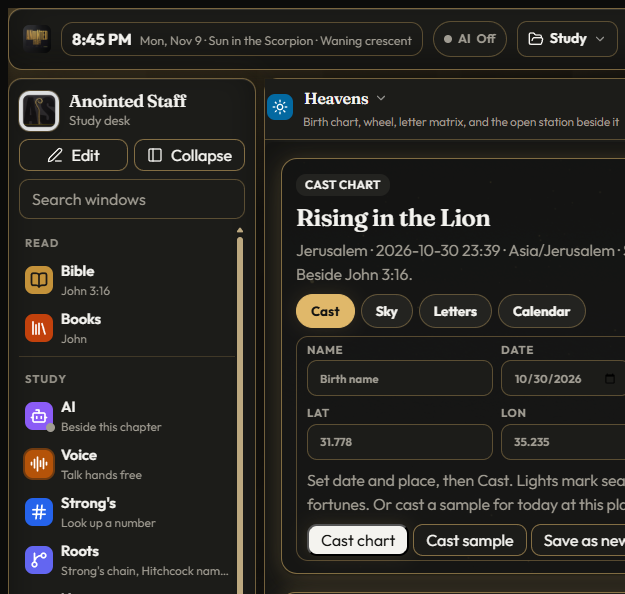
Heavens opens a chart beside an open chapter. The cast form does not whisper a weekly horoscope. Its copy is deliberate: lights mark seasons beside Scripture — clocks and glory, not fortunes. That sentence is the product.
The fence first
Isaiah 47:13 is not a decorative footnote. The desk refuses monthly prognosticators as a stance, not as an afterthought in the About page. Aspects on the wheel are labeled as geometry — tension or ease in the old tables — not a ruling over a life. Cast reports and PDF exports repeat the same fence in denser prose so a note you keep later still carries the warning.
If you came looking for birth-angel calendars that tell you what to do on Tuesday, this room will disappoint you on purpose.
Lore of clocks and glory
The mystical tone of Anointed Staff allows awe at the sky without handing the sky your will. Psalm 19 and Job 38 already speak of heavens that declare and of constellations named in poetry. The desk’s Heavens tools point back into that Scripture library. They do not invent a second gospel written in houses and decans.
“Clocks” means seasons, rising, setting, angles you can measure. “Glory” means the wonder the text already names. Neither word means fate for sale.
What you can study
Cast
Set a place (Jerusalem is the default teaching city; Custom place can search Nominatim with a leave-device confirm). Choose civil time, Whole Sign or Equal houses, and cast. A sample cast for “now” at a place exists for teaching the wheel — not for predicting a week.
Identity fields exist because a chart needs a when and a where. Study this sky will confirm before sending that identity to a non-local model host.
Witness
Witness walks a Scripture path around stations (Virgin → Lion framing in the desk’s teaching path). Station chips point back to verses already in the library. Keep John, Numbers, or Psalms open while you step. The chart is a companion pane, not a replacement chapter.
Decans, Circle, Camp, Job 38, Psalm 19
These study tools sit under the cast. They are not a fortune deck. Decans name thirty-six figures for historical reading. Camp cherub typology and Job star-name lexicon stay in the language of Scripture study. Circle / Scripture twelves keep the geometry honest without inventing oracles.
Rolleston and Mazzaroth
Extra-canon ships Frances Rolleston’s Mazzaroth (1862, public domain, curated) as historical reading beside Job 38 — not as a birth-angel calendar. Open it from the shelf described in Extra-canon as a public-domain shelf, then return to Heavens with the fence intact.
How it works beside the Word
- Open a chapter you actually mean to read.
- Open Heavens → Cast. Set place and time.
- Cast, then leave the chart beside the text.
- Use Witness or station chips when you want Scripture paths around the stations.
- Export or note only what you need; the report text keeps the clocks-not-fortunes language.
- If you ask a model to “study this sky,” confirm the leave-device prompt.
Quiet Practice and offline Hear do not require Heavens. They share the same local-first posture — see Offline Practice · quiet desk.
What Heavens refuses
- Monthly “what the stars say for you” copy
- Ritual or seal instructions dressed as astronomy
- Smuggling Extra-canon Hermetica into Cast as destiny
- Silent uploads of birth data to a cloud without a confirm
The mystical landing page may speak of lamp-night and sky. The Cast engine still speaks of clocks. Keep both sentences; do not let marketing soften the fence.
Why this belongs on a Scripture desk
Scatter is the enemy: one app for Bible, one site for “biblical astronomy,” one forum for charts with no verse in sight. Anointed Staff keeps the chapter as the center and lets the sky be a pane with a conscience. Geometry can sit beside Genesis without replacing it. Seasons can sit beside Leviticus without selling a month.
That is the lore worth keeping — awe with a railing.
Download and cast locally
Charts and notes stay on the machine. Download for Windows or open the source monorepo. Cast beside a chapter; read Isaiah 47 before you read any aspect label as fate.